NSFAS Funding Details for Postgraduate Students: Eligibility, Application Details of Eligible and Ineligible Students in the Fund
Postgraduate education opens doors to better skills, higher qualifications, and stronger career opportunities. For many South African students, however, the biggest obstacle is not academic ability but money. Tuition fees, accommodation costs, and everyday living expenses increase sharply at postgraduate level, making further study feel out of reach.
This is why so many students search for NSFAS funding for postgraduate students. Unfortunately, the information available online is often outdated or incomplete. Many students apply with hope, only to face rejection because they misunderstand what NSFAS actually supports. This guide clears that confusion by explaining, in simple language, who qualifies, who does not, and what options exist if NSFAS is not available.
Does NSFAS Fund Postgraduate Students in 2026?
The honest answer is simple: NSFAS does not fund most postgraduate studies in 2026. The scheme mainly supports undergraduate degrees and TVET college programmes. Postgraduate funding is extremely limited and only applies to a few specific qualifications linked to national priorities.
The confusion exists because, in previous years, NSFAS funded small postgraduate pathways such as teaching-related programmes. These opportunities were never guaranteed and depended on government budgets and skills shortages. In 2026, this limited support continues, but it is not open to general honours, master’s, or PhD students.
Understanding the Purpose of NSFAS
NSFAS was created to help students from low-income households access higher education for the first time. Its core mission is to remove financial barriers at entry level, not to fund advanced academic research or professional specialisation.
Because public funds are limited, NSFAS focuses on:
- First undergraduate qualifications
- TVET college training
- Students from poor and working-class households
Postgraduate studies are considered a different category. They are mainly funded through research councils, government departments, universities, and private foundations rather than NSFAS.
You can also read: Any Failure During NSFAS Verification
NSFAS Funding Scope at Postgraduate Level
NSFAS postgraduate funding exists only in special cases. These are usually linked to teaching or national skills shortages and are not available every year.
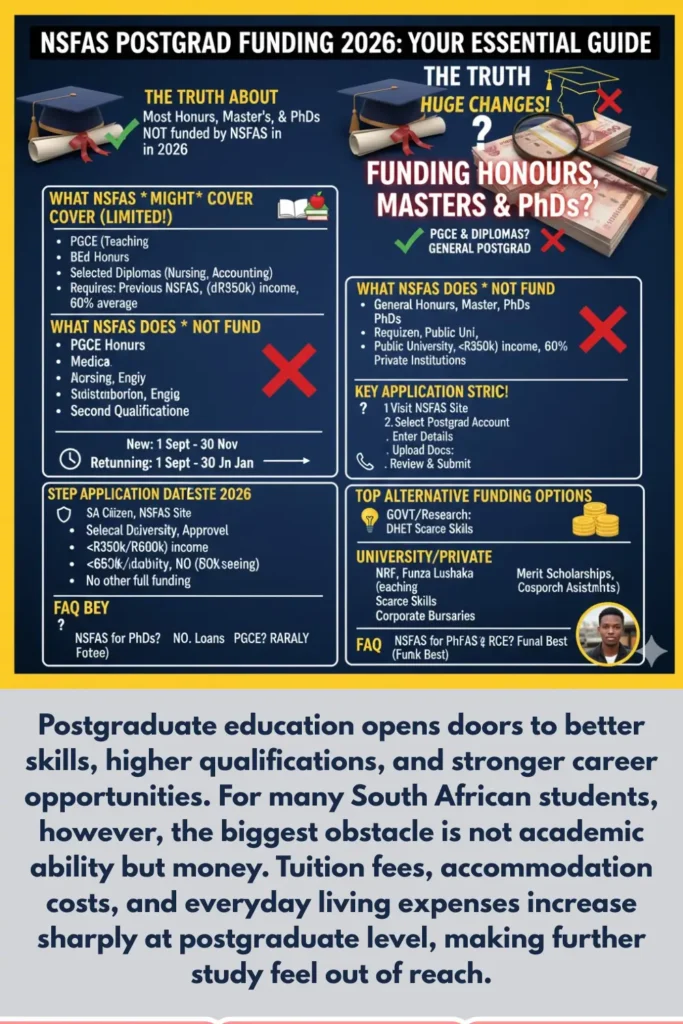
Possible funded qualifications include:
- PGCE (Postgraduate Certificate in Education)
- BEd Honours
- Selected postgraduate diplomas
- Programmes linked to nursing, engineering, or accounting
These options often require that the student:
- Previously received NSFAS funding as an undergraduate
- Studies at a public university
- Meets income and academic requirements
Qualifications Not Funded by NSFAS
In 2026, NSFAS does not fund:
- General honours degrees
- Master’s degrees
- PhD programmes
- Medical specialisations
- Most postgraduate diplomas
- Second qualifications
- Private institution programmes
If your course falls into this category, you must explore alternative funding options.
Eligibility Criteria for NSFAS Postgraduate Funding
Eligibility is strict. Missing even one requirement usually results in rejection.
To qualify, you must meet all of the following:
- Be a South African citizen
- Study at a public university
- Be registered for an approved postgraduate programme
- Meet household income thresholds
- Achieve at least a 60% academic average
- Not receive full funding from another bursary
Income Limits for Postgraduate NSFAS Applicants
| Category | Annual Household Income Limit |
|---|---|
| Standard Applicants | R350,000 or less |
| Applicants with Disabilities | R600,000 or less |
These limits include income from parents, guardians, or spouses. NSFAS verifies income through official documents and databases.
NSFAS Application Dates for Postgraduate Students
Postgraduate applications follow the standard NSFAS cycle when available.
Key dates include:
- New applications: 1 September to 30 November
- Returning students: 1 September to 31 January
Late applications are not accepted, and missing deadlines means waiting another year.
Step-by-Step NSFAS Postgraduate Application Process
Applying is done online through the myNSFAS portal.
Steps include:
- Visit the NSFAS website
- Log in or create a myNSFAS account
- Select postgraduate funding
- Enter personal and academic details
- Upload required documents
- Review and submit
Once submitted, applications cannot be edited unless NSFAS reopens the file.
You can also read: SASSA R8,070 January 2026
NSFAS Postgraduate Document Requirements
Required documents include:
- Certified South African ID
- Proof of household income
- Academic transcript
- University admission letter
- NSFAS consent forms
Common mistakes that cause rejection:
- Blurry scans
- Expired certifications
- Incorrect file formats
- Missing signatures
What NSFAS Covers for Eligible Postgraduate Students
Funding is limited but structured.
Coverage may include:
- Full tuition fees
- Registration fees
- Monthly living allowance
- Study material allowance
- Accommodation support
- Disability-related assistance
Amounts vary yearly based on available budgets.
NSFAS Application Status and Tracking
You can track your application through:
- myNSFAS portal
- USSD code
- WhatsApp support
Common status meanings:
- Application submitted
- Verification in progress
- Provisionally funded
- Fully funded
- Rejected
NSFAS Appeals for Postgraduate Applicants
Appeals are allowed only under specific conditions.
You may appeal if:
- Household income changed
- A parent passed away
- Documents were unclear
Appeals must be submitted within 30 days. Appeals for master’s or PhD funding are not accepted.
NSFAS Postgraduate Loans Explained
NSFAS does not provide loans. It is a bursary and grant system only. Students needing loans must approach banks, education finance companies, or employer schemes.
Best Alternative Funding Options for Postgraduate Students
Since NSFAS support is limited, most students rely on other sources.
Government and Research Bursaries
- NRF postgraduate bursaries
- Funza Lushaka (for teaching)
- DHET scarce skills funding
University and Private Funding
- Faculty merit scholarships
- Research assistantships
- Corporate bursaries
- International foundations
Postgraduate Funding for Teaching and PGCE Students
PGCE students should not rely on NSFAS. The most reliable option is the Funza Lushaka Bursary, which covers tuition, accommodation, and living costs in exchange for a teaching service commitment.
You can also read: NSFAS Payment Dates and Allowance Schedule
Funding Options for International Postgraduate Students
International students cannot access NSFAS. Alternatives include:
- University international scholarships
- Embassy bursaries
- Home-country funding
- Research assistant roles
Tips to Improve Your Chances of Getting Postgraduate Funding
Strong strategies include:
- Applying early
- Maintaining high academic performance
- Writing tailored motivation letters
- Applying to multiple bursaries
- Preparing a clear research proposal
Common Funding Mistakes Students Make
Avoid:
- Applying late
- Submitting generic applications
- Ignoring eligibility rules
- Uploading poor-quality documents
Small errors often lead to rejection.
Conclusion
NSFAS funding for postgraduate students in 2026 is extremely limited and often misunderstood. While a few teaching-related or priority qualifications may qualify, most honours, master’s, and PhD programmes are not funded. Understanding these limits early helps you avoid wasted time and focus on realistic funding options such as government bursaries, university scholarships, and private foundations. With proper planning and persistence, postgraduate study remains possible, even without NSFAS.
You can also read: SRD SASSA Status Check 2026 Check USSD