Question Many South African Students have is will NSFAS Reopen in January 2026?
Every year, thousands of South African students ask the same urgent question when January arrives: Will NSFAS reopen for applications? For the 2026 academic year, this question is especially important for students who missed the main application window.
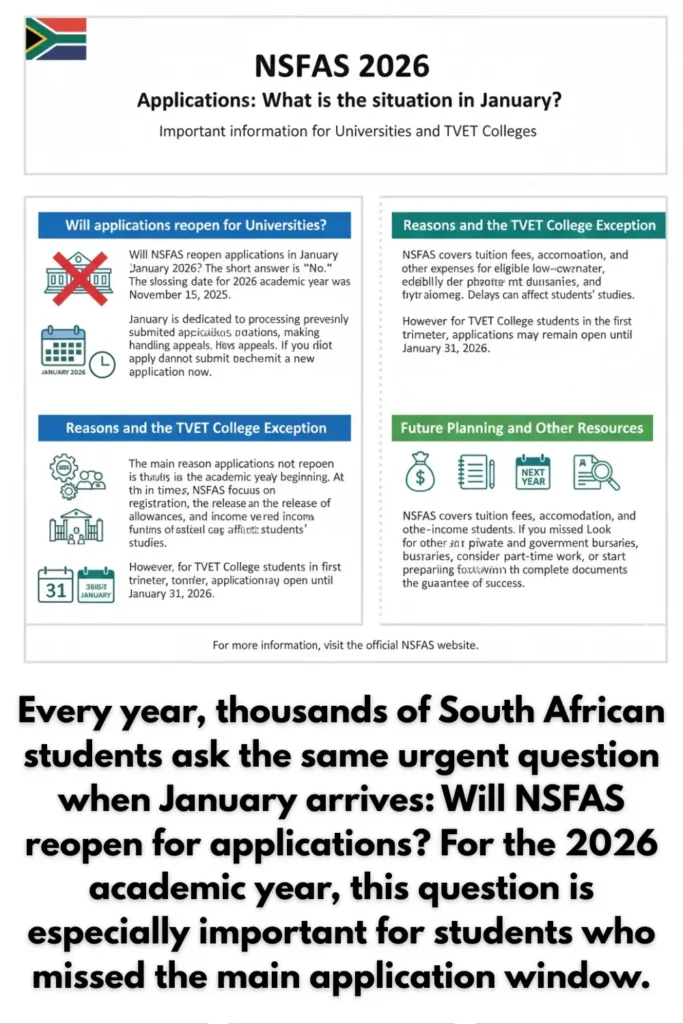
The short answer is no for new university applications, but the full explanation is more detailed. Understanding how NSFAS works, why deadlines exist, and what options remain can help students make better decisions for their future.
Understanding NSFAS and Why It Matters for Students
The National Student Financial Aid Scheme (NSFAS) is a government-funded program created to help students from low-income households access higher education. It removes financial barriers that often prevent capable students from studying further.
NSFAS does more than just pay tuition. It supports students throughout the academic year, allowing them to focus on their studies instead of financial stress.
You can also read: R350 SRD Grant for January 2026
Who NSFAS Is Designed to Help
NSFAS mainly supports students who come from families that cannot afford university or TVET college fees. The aim is to promote equal access to education and improve long-term employment opportunities.
NSFAS funding applies only to public universities and TVET colleges in South Africa.
NSFAS Application Timeline for the 2026 Academic Year
Applications for the 2026 academic year opened between 15 and 17 September 2025. This early opening allows NSFAS enough time to assess applications before the academic year begins.
Students are expected to apply months in advance so that funding decisions are ready before registration.
Official and Extended Closing Dates Explained
The main closing date for NSFAS 2026 applications was 15 November 2025. However, some reports indicated a possible extension until 31 January 2026, mainly affecting specific categories like TVET colleges.
It is important to understand that extensions are not guaranteed and usually do not apply to all students.
Will NSFAS Accept New Applications in January 2026
For university students, NSFAS does not reopen brand-new applications in January 2026. If you did not apply during the official application period, you cannot submit a new application for the 2026 academic year. January is reserved for processing existing applications, not accepting new ones.
Special Case for TVET College Students
TVET college students follow a different system. For first-trimester TVET students, applications ran from 1 September 2025 to 31 January 2026. This means some TVET students may still apply in January, depending on their college and programme.
Why NSFAS Does Not Reopen Applications in January
January is when universities and colleges officially start the academic year. Students need confirmed funding to register and attend classes.
Opening applications in January would delay:
- Registration
- Class attendance
- Release of allowances
Verification, Funding, and Institutional Planning
NSFAS must verify income details with SARS and SASSA, review documents, and communicate results to institutions. This process takes weeks or months. Universities also need early confirmation of funded students to manage admissions and housing.
You can also read: NSFAS Bursaries At False Bay TVET College 2026
What NSFAS Focuses on During January
In January, NSFAS finalizes applications submitted in 2025. Students receive confirmation of approval, rejection, or conditional approval. Approved students can then proceed with registration without upfront payments.
Appeals and Returning Students
January is also dedicated to:
- Processing appeals for rejected applications
- Reviewing academic performance of continuing students
- Renewing funding for eligible returning students
Who Qualifies for NSFAS Funding
To qualify, applicants must:
- Be South African citizens
- Have a valid South African ID
- Be accepted at a public university or TVET college
Private institutions are not funded by NSFAS.
Household Income Thresholds
NSFAS funding depends on household income:
- Up to R350,000 per year qualifies for a bursary
- R350,000–R600,000 may qualify for a loan
- Students with disabilities qualify up to R600,000
Documents Needed for a Successful NSFAS Application
Applicants must prepare:
- Certified copy of South African ID
- Signed consent form
- Valid email address and cellphone number
Having documents ready early improves approval chances.
Special Categories and Exceptions
Additional documents may include:
- Proof of income for parents or guardians
- Disability Annexure A Form (if applicable)
- Vulnerable Child Declaration Form (if applicable)
SASSA grant recipients do not need income proof.
What NSFAS Funding Covers
NSFAS pays tuition fees directly to institutions. Accommodation is covered for students in residences or approved private housing. This ensures students are not excluded due to unpaid fees.
Monthly Allowances and Living Support
Students also receive allowances that support daily needs and academic requirements.
NSFAS Allowances Overview
| Allowance Type | What It Covers |
|---|---|
| Tuition Fees | Full course costs paid to institution |
| Accommodation | University or approved private housing |
| Living Allowance | Food and daily expenses (R14,000 annually) |
| Book Allowance | Study materials and textbooks (R5,000) |
| Transport Allowance | Travel costs for students living far from campus |
| Personal Care | Essential personal items |
What to Do If You Missed the NSFAS Deadline
If you missed NSFAS, consider:
- Other national and private bursaries
- Employer-linked bursary schemes
- Sector education bursaries
Applying to multiple bursaries increases your chances.
Academic and Financial Planning Choices
Other options include:
- Delaying studies and applying next year
- Working while studying part-time
- Enrolling at a TVET college with open funding windows
How to Prepare for the Next NSFAS Application Cycle
To improve future success:
- Apply immediately when applications open
- Prepare documents months in advance
- Track your application regularly
Early preparation reduces stress and mistakes.
Common Mistakes to Avoid
Avoid:
- Uploading unclear documents
- Using incorrect income information
- Ignoring NSFAS emails or SMS notifications
You can also read: Srd SASSA Appeal Status Check Step-by-step
Where Students Can Get Help with NSFAS
Students can get assistance through:
- NSFAS official website and contact centre
- University financial aid offices
- NYDA and Thusong Centres
- NSFAS outreach and walk-in programs
These services are designed to support students throughout the process.
Conclusion
NSFAS does not reopen new university applications in January 2026, but understanding the system helps students avoid missing future opportunities. Missing one deadline does not mean the end of your education journey.