NSFAS Eligibility Requirements 2026 Full Criteria and Qualified Applicants
Navigating university or TVET college fees can feel like standing at the foot of a mountain with no clear path up. For millions of South African students, the National Student Financial Aid Scheme, better known as NSFAS, acts as that much-needed bridge between ambition and opportunity. It exists to ensure that financial hardship does not become the reason a capable student is locked out of higher education.
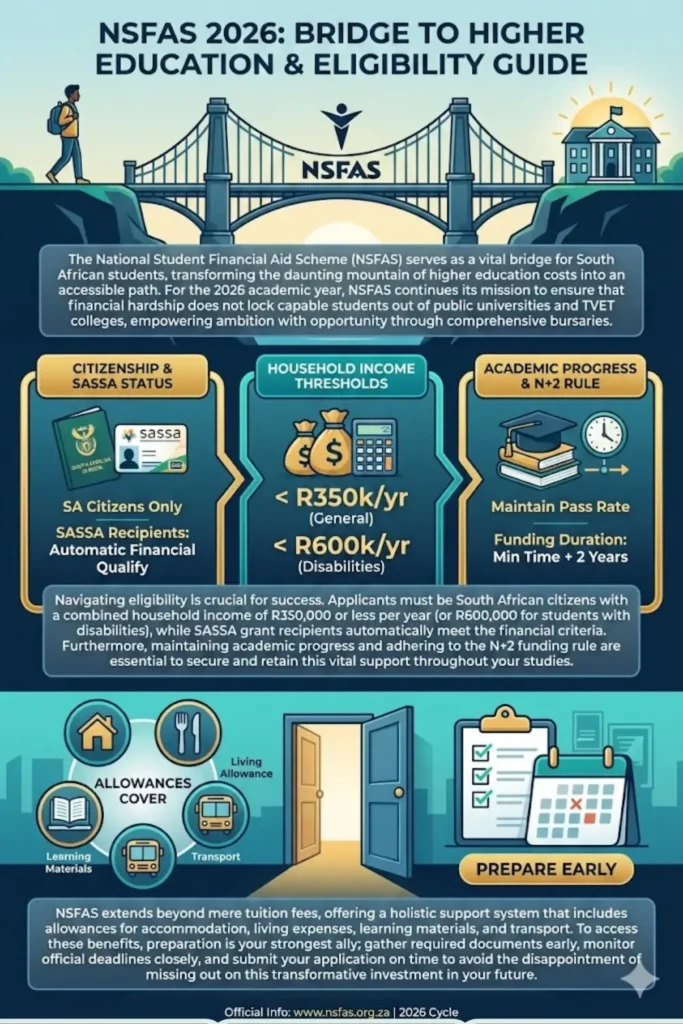
NSFAS funding for 2026 continues this mission by supporting students from low-income households with bursaries that cover essential study costs. Understanding the eligibility requirements is not just helpful, it is essential. One missed detail can mean missing out entirely, which is why knowing the full criteria early gives you a serious advantage.
Understanding NSFAS for the 2026 Academic Year
NSFAS is more than just tuition support. It is a comprehensive funding system designed to help students focus on learning instead of worrying about money. For the 2026 academic year, NSFAS funding remains focused on public institutions and students who genuinely need financial assistance.
The scheme is specifically aimed at:
- Students from financially disadvantaged households
- Learners entering higher education for the first time
- Continuing students who meet academic progression rules
By keeping the eligibility focused, NSFAS ensures funds reach those who need them most.
You can also read: SASSA Payment Date for SRD R370 Grant Check
Citizenship Requirements for NSFAS 2026
To qualify for NSFAS in 2026, citizenship is non-negotiable. Applicants must be South African citizens with a valid South African ID number. This requirement exists because NSFAS is funded by public money meant to support citizens of the country.
Key points to remember:
- Only South African citizens qualify
- Permanent residents and international students are not eligible
- A valid ID is mandatory during application
Without meeting this basic requirement, the application process stops before it begins.
NSFAS Household Income Thresholds
Income plays a major role in NSFAS eligibility. The scheme uses household income to measure financial need and decide who qualifies for funding.
General Applicants
For most applicants, the combined annual household income must be:
- R350,000 or less per year
Students with Disabilities
Recognizing the additional costs faced by students living with disabilities, NSFAS allows a higher income threshold:
- R600,000 or less per year
SASSA Grant Beneficiaries
Students who receive SASSA grants fall into a special category:
- Automatically meet the financial requirement
- Still required to apply formally
This income-based approach ensures fairness while addressing different levels of financial need.
NSFAS Eligibility Based on SASSA Grants
If you are a SASSA grant recipient, NSFAS already recognizes your financial vulnerability. This means you automatically qualify financially for NSFAS funding in 2026. However, automatic qualification does not mean automatic approval.
You must still:
- Submit an NSFAS application
- Meet academic progression requirements
- Be registered at a public institution
Think of SASSA status as a fast-track for income verification, not a free pass through the system.
The NSFAS N+2 Rule Explained
The N+2 rule often confuses students, but it is actually quite simple. NSFAS allows funding for the minimum duration of a qualification (N) plus two additional years.
For example:
- A 3-year degree can be funded for up to 5 years
- A 4-year degree can be funded for up to 6 years
Students Registered Before 2018
If you first registered at a public university before 2018, a different income rule applies:
- Household income at first registration must have been R122,000 or less
- You must still be within the N+2 funding period
This rule prevents indefinite funding while still offering flexibility.
Academic Eligibility Criteria for NSFAS
Academic performance is just as important as financial need. NSFAS expects students to show commitment to their studies.
For new applicants:
- Must meet institution admission requirements
- Must apply for a funded qualification
For continuing students:
- Must pass required modules
- Must meet academic progression standards
Failing to progress academically can result in funding being withdrawn, even if financial criteria are met.
Eligible Institutions for NSFAS Funding
NSFAS funding is limited to public institutions only.
Eligible institutions include:
- Public universities in South Africa
- Public TVET colleges
Not eligible:
- Private universities
- Private colleges
- Short courses not linked to qualifications
Always confirm that your institution is NSFAS-accredited before applying.
You can also read: NSFAS Disbursed R3.6 Billion to Universities
Funded Qualifications Under NSFAS
NSFAS focuses on qualifications that lead to meaningful employment opportunities.
Funded programs include:
- Undergraduate degrees
- Diplomas
- Higher certificates
- Selected TVET occupational programs
Postgraduate funding is extremely limited and subject to special announcements.
Who Does Not Qualify for NSFAS 2026
Understanding who does not qualify can save you time and disappointment.
You do not qualify if you are:
- A part-time student
- Enrolled at a private institution
- Exceeding income thresholds
- Outside the N+2 funding period
NSFAS funding is strictly for full-time students at public institutions.
NSFAS Allowances Explained
NSFAS does not only pay tuition. It covers several study-related costs to ease student life.
Common allowances include:
- Tuition and registration fees
- Accommodation (private or university residence)
- Living allowance
- Learning materials allowance
- Transport allowance (where applicable)
These allowances ensure students can focus on studying instead of survival.
Required Documents for NSFAS Application
Having documents ready early makes the application process smoother.
You will need:
- Certified copy of your South African ID
- Parents’ or guardians’ ID copies
- Proof of household income
- Academic records or results
- Signed consent form
Missing documents are one of the top reasons applications are delayed or rejected.
Step-by-Step Preparation Before Applying
Preparation is the silent advantage most students overlook. Start early and stay organized.
Helpful steps:
- Create a folder for all documents
- Double-check income information
- Monitor official NSFAS announcements
- Apply as soon as applications open
Early preparation reduces stress and mistakes.
Key NSFAS Dates and Deadlines for 2026
NSFAS does not usually accept late applications. Missing the deadline often means waiting an entire year.
Important reminders:
- Applications open once per cycle
- Deadlines are strict
- Late submissions are rarely accepted
Applying early also helps avoid website congestion.
NSFAS Eligibility Summary Table
| Eligibility Factor | Requirement |
|---|---|
| Citizenship | South African citizen |
| Household Income | ≤ R350,000 per year |
| Disabled Students | ≤ R600,000 per year |
| SASSA Recipients | Automatically qualify financially |
| Study Mode | Full-time only |
| Institution | Public university or TVET college |
| Academic Progress | Required for continuing students |
NSFAS is not just financial aid; it is an opportunity engine. For students who meet the eligibility requirements, it opens doors that would otherwise remain closed. The key is understanding where you stand and acting early. When you know the rules, you play the game smarter.
Conclusion
Securing NSFAS funding for 2026 starts with one crucial step: understanding the eligibility requirements. From income thresholds to academic rules and citizenship criteria, every detail matters. If you meet the requirements, preparation becomes your strongest ally. Gather your documents, monitor official updates, and apply early. Education is an investment in your future, and NSFAS exists to make that investment possible without the burden of financial stress.
You can also read: How to Check SASSA eKYC Pending Status