SRD Appeal Rejections Check Top Reasons 2026
The SRD appeal rejections can be totally frustrating, especially when you genuinely believe you qualify for the R350 grant. Many South Africans submit a SASSA appeal only to receive another decline, often without a clear explanation. In most cases, this does not mean permanent ineligibility. It usually points to system checks, data mismatches, or verification delays that can be corrected.
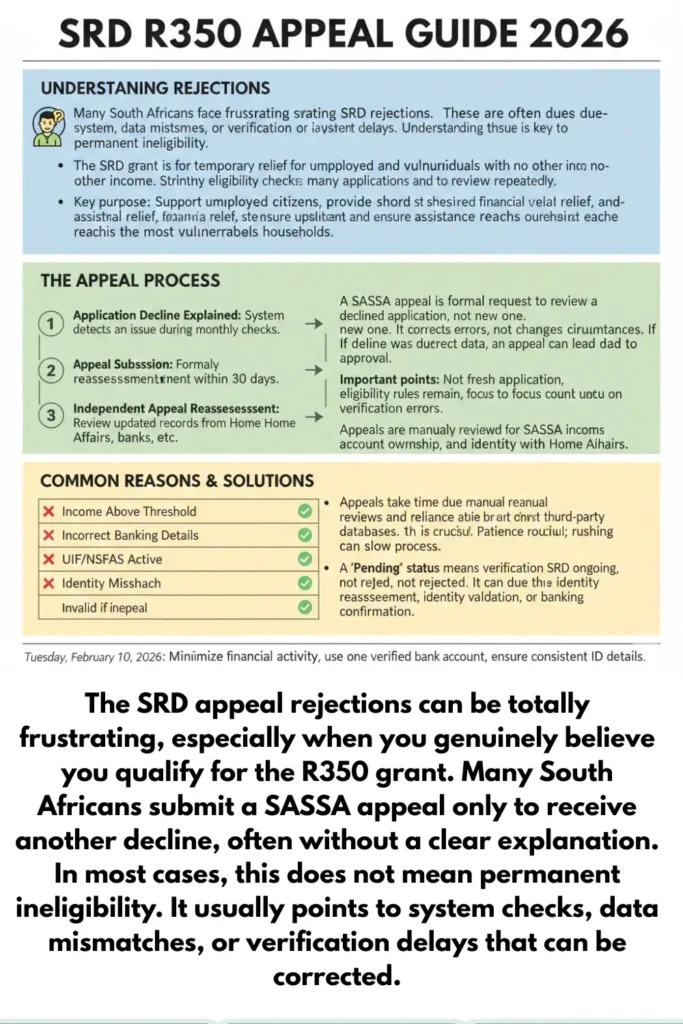
Understanding why appeals are rejected in 2026 gives you control. Once you know what SASSA checks, how appeals are reviewed, and which mistakes cause delays, you can avoid unnecessary rejections and improve your chances of approval.
Understanding the SRD R350 Grant in 2026
The Social Relief of Distress (SRD) grant was introduced to support unemployed and vulnerable individuals who have no other form of income. Even in 2026, the grant remains a lifeline for millions of South Africans facing economic uncertainty.
The SRD grant is not permanent income support. Instead, it is designed for temporary financial relief. This is why strict eligibility checks are applied every month, and why many applications and appeals face ongoing reviews.
Key purpose of the SRD grant includes:
- Supporting unemployed citizens with no income
- Providing short-term financial relief
- Ensuring assistance reaches the most vulnerable households
You can also read: How to Appeal an NSFAS Rejection
What Is a SASSA Appeal for R350
A SASSA appeal for R350 is a formal request asking for a declined SRD application to be reviewed again. It does not create a new application and does not change eligibility rules. Instead, it allows an independent authority to reassess your existing application using updated records.
Many applicants confuse an appeal with reapplying. An appeal focuses on correcting errors, not changing circumstances. If the decline was due to incorrect data or system assumptions, an appeal can lead to approval.
Important points to remember:
- An appeal is not a fresh application
- Eligibility rules remain the same
- Appeals focus on verification errors
The Three Key Stages of the SRD Appeal Process
Stage One – Application Decline Explained
An application decline happens after SASSA completes monthly verification checks. These checks include income monitoring, identity verification, and database comparisons. A decline often means the system detected an issue, not that you are permanently disqualified.
Stage Two – Appeal Submission
At this stage, you formally request a reassessment within the allowed timeframe. Submitting an appeal signals that you believe the decision was incorrect due to data mismatch or verification error.
Stage Three – Independent Appeal Reassessment
Once submitted, your appeal is reviewed independently using updated records. This includes Home Affairs, banking systems, and income verification databases. The outcome may differ from the original decision.
How the SRD Appeal Review Process Works
After submission, appeals are not handled by the same automated system. They are sent for independent reassessment to ensure fairness.
During this process, SASSA reviews:
- Monthly income records
- Bank account ownership
- Identity verification with Home Affairs
Income Checks
Temporary deposits, refunds, or once-off transfers can be flagged as income. These are reassessed during appeals to confirm whether they are recurring or not.
Identity and Banking Verification
Even small mismatches in ID numbers or banking details can lead to rejection. Accuracy is critical during reassessment.
You can also read: SASSA Status Check for R350 Payment Dates
Why SRD Appeal Decisions Take Longer Than Expected
Appeals take time because they are manually reviewed. Each case is assessed individually and relies on multiple third-party databases.
Common causes of delays include:
- Pending income confirmation
- Bank verification backlogs
- Home Affairs record updates
Patience is important, as rushing or resubmitting appeals can slow the process further.
What a Pending SRD Appeal Status Really Means
A pending status does not mean rejection. It simply indicates that one or more verification steps are still ongoing.
Pending may occur due to:
- Income reassessment in progress
- Identity validation delays
- Banking confirmation checks
In many cases, pending appeals are approved once verification is completed successfully.
Top Reasons SRD Appeals Get Rejected in 2026
Income Detected Above the SRD Threshold
SASSA reviews bank activity monthly. Temporary deposits like family support or refunds can be mistaken as income. If similar transactions continue, the appeal may be rejected.
Incorrect or Outdated Banking Details
Banking issues are a major cause of rejections. These include:
- Accounts not in the applicant’s name
- Closed or inactive accounts
- Third-party bank accounts
UIF or NSFAS Records Still Active
Old employment or student funding records may still appear active. If databases are not updated, the system assumes ongoing financial support.
Identity Verification and Home Affairs Mismatch
Spelling errors, incorrect ID numbers, or outdated records can trigger rejection. Identity details must match exactly across all systems.
Appealing Without a Valid Reason
Appeals are meant for correcting errors, not changing eligibility. Appealing despite clear ineligibility usually leads to immediate rejection.
SRD Appeal Rejection Reasons and Solutions
| Rejection Reason | Why It Happens | Practical Solution |
|---|---|---|
| Income detected | Temporary deposits flagged | Avoid unnecessary deposits during review |
| Banking issues | Account not in applicant name | Update banking details correctly |
| UIF or NSFAS linked | Old records still active | Confirm databases are updated |
| Identity mismatch | Home Affairs discrepancies | Correct ID details before appeal |
| Invalid appeal reason | Eligibility rules not met | Reapply instead of appealing |
How to Avoid SRD Appeal Rejection
Before submitting an appeal, carefully review the decline reason. Appeals are most successful when there is a clear error.
Steps to take before appealing:
- Verify income records
- Confirm banking details
- Check Home Affairs information
Knowing when to appeal and when to wait can prevent unnecessary rejections.
Important Deadlines and Appeal Timeframes
Appeals must be submitted within 30 days of the decline. Missing this window results in automatic rejection, regardless of eligibility.
Submitting early improves your chances by allowing enough time for reassessment before the next payment cycle.
Tracking Your SRD Appeal Status Correctly
Regular status checks help you stay informed and respond quickly if updates are required.
Avoid these mistakes:
- Checking status too frequently
- Submitting multiple appeals
- Changing details during review
SRD Appeal Status Types and Meanings
| Status | Meaning |
|---|---|
| Pending | Verification in progress |
| Approved | Appeal successful |
| Declined | Appeal unsuccessful |
| No record | Appeal not submitted correctly |
Tips to Improve Your SRD Appeal Success Rate
Small habits can make a big difference:
- Keep financial activity minimal during review
- Use one verified bank account
- Ensure ID details are consistent
Many believe repeated appeals increase approval chances. In reality, incorrect appeals can delay outcomes. SASSA focuses on verified data, not the number of submissions.
Conclusion
An SRD appeal is more than a follow-up step. It is a critical opportunity to correct errors that may block essential financial support. Most rejections happen due to avoidable issues like income misinterpretation, outdated banking details, or identity mismatches.
You can also read: SASSA Child Support Grants March 2026
By understanding the appeal process, tracking your status carefully, and preparing accurate information, you significantly improve your chances of success in 2026.