NSFAS Approves Funding 626 000 Applicants Details Step by Step

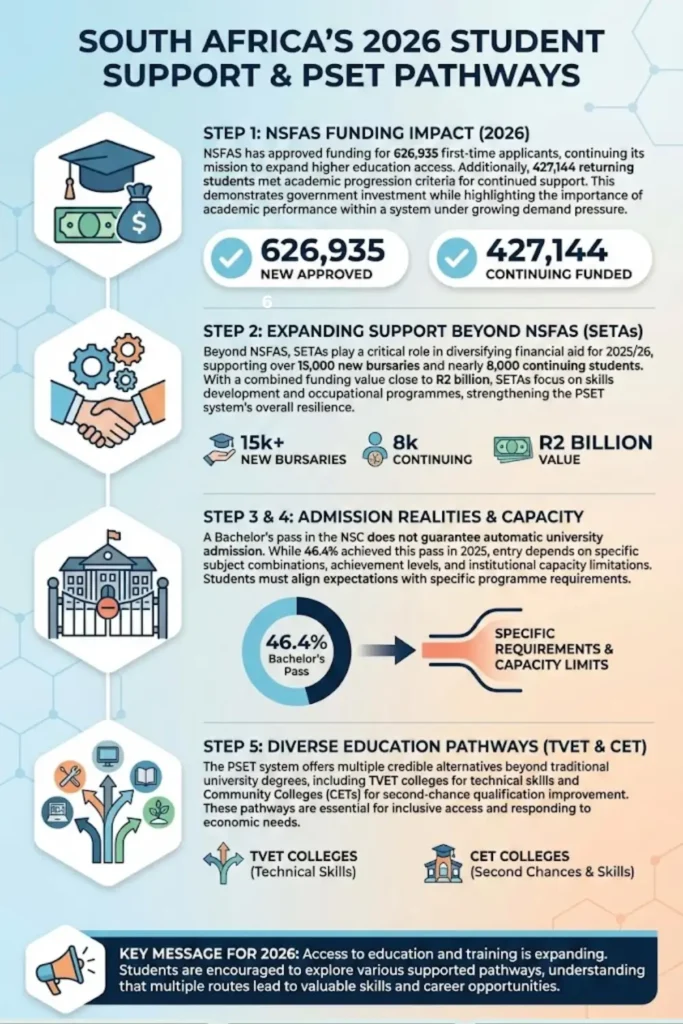
The 2026 academic year brings important developments for students seeking financial support through the National Student Financial Aid Scheme. Government has confirmed that 626,935 first-time applicants have been approved for funding, while 427,144 continuing university students have met the required academic progression criteria.
This announcement was made during a media briefing on the readiness of the Post-School Education and Training (PSET) sector. The update highlights both progress and pressure within South Africa’s higher education funding system, especially as more learners qualify for university entrance each year.
NSFAS Funding Approvals for 2026
The approval of more than 626,000 new applicants shows that NSFAS remains a key driver of access to higher education for poor and working-class students. At the same time, over 427,000 returning students successfully met progression requirements and will continue receiving support.
This confirms two important realities:
- NSFAS continues to expand access to higher education.
- Academic performance remains essential for continued funding.
- The funding system is under growing pressure due to rising demand.
- More students are qualifying for higher education than ever before.
The funding model is currently supported by short-term stabilisation measures, while government develops a more sustainable long-term solution. In addition, the “missing-middle” funding initiative is being expanded to assist students who fall outside the traditional NSFAS income threshold but still struggle to afford tuition.
You can also read: NSFAS Status Check Using ID Number 2026
The Role of SETAs in Expanding Student Support
Beyond NSFAS, Sector Education and Training Authorities (SETAs) are playing a critical role in widening access to education funding. SETAs focus mainly on skills development, workplace training, and sector-specific qualifications.
For the 2025/26 funding cycle:
- Over 15,000 new bursary beneficiaries are supported by SETAs.
- Nearly 8,000 continuing students are receiving ongoing assistance.
- The combined funding value is close to R2 billion.
- Funding covers both academic and occupational programmes.
This diversification of funding sources reduces dependency on NSFAS alone. It also strengthens the overall resilience of the PSET system by ensuring students have multiple pathways to financial support.
Understanding the Bachelor’s Pass Misconception
During the briefing, Higher Education and Training Minister Buti Manamela addressed a common misunderstanding: a Bachelor’s pass in the National Senior Certificate (NSC) does not automatically guarantee university admission.
In the 2025 NSC results:
- 46.4% of candidates achieved a Bachelor’s pass.
- 28.1% obtained a Diploma pass.
- 13.5% achieved a Higher Certificate pass.
- More than 40% did not achieve a Bachelor’s pass.
Although a Bachelor’s pass qualifies a learner to apply for university, admission depends on several additional factors:
- Specific subject combinations.
- Minimum achievement levels in required subjects.
- Faculty and programme capacity limits.
- Competitive selection processes.
This often leads to disappointment among learners and families, not because students failed, but because expectations were not aligned with institutional requirements.
You can also read: SRD dsd gov za Appeal Status Check
Capacity Challenges in the PSET System
The Post-School Education and Training system currently provides approximately 535,000 funded and planned spaces across different institutions. These include:
- Universities
- Technical and Vocational Education and Training (TVET) colleges
- Community Education and Training (CET) colleges
- Skills development programmes
- Workplace-based learning opportunities
However, the increase in matric pass rates has significantly increased demand. The gap between the number of qualified learners and available spaces is structural and longstanding.
Overview of Available PSET Spaces
| Institution Type | Description | Role in the System |
|---|---|---|
| Universities | Academic degree programmes | Prepare students for professional careers |
| TVET Colleges | Technical and vocational training | Focus on practical skills and industry needs |
| CET Colleges | Community-based education | Provide second chance and adult education |
| Skills Programmes | Short-term occupational courses | Improve employability |
| Workplace Learning | Learnerships and apprenticeships | Combine training with real work experience |
The system is under pressure, but government maintains that it is undergoing deliberate reform rather than facing collapse.
Community Colleges and Second Chance Opportunities
Community Education and Training colleges are central to inclusive access, especially for youth and adults who want to improve their qualifications. These institutions are fully prepared for the 2026 academic year.
They offer:
- Amended Senior Certificate programmes.
- National Senior Certificate Second Chance Programme.
- Occupational qualifications.
- Skills development courses.
These pathways ensure that students who did not achieve their desired results still have meaningful opportunities to continue learning and improving their prospects.
Why Multiple Education Pathways Matter
Education, training, and skills development carry equal social and economic value. Not every learner will enter university immediately, and not every career requires a traditional academic degree.
A well-functioning system must:
- Offer clear and well-communicated options.
- Provide financial support across different education types.
- Ensure smooth transitions between qualifications.
- Support lifelong learning opportunities.
Multiple pathways are not a compromise. They strengthen the country’s ability to respond to economic and social needs.
You can also read: NSFAS 2026 Applications Finalised Status
Final Thoughts
The approval of 626,935 first-time applicants and continued support for over 427,000 returning students demonstrates the scale of government investment in education. While funding pressures remain, reforms are underway to create a more sustainable and diversified system.
Students and families must understand that a Bachelor’s pass is only one step in a larger journey. Admission depends on programme requirements and available capacity. Fortunately, the PSET system offers various credible alternatives that allow every learner to pursue further education, training, and skills development.