NSFAS Funding UNISA Courses in 2026 Check Full List of UNISA Courses

Studying at the University of South Africa (UNISA) is a dream for thousands of students each year. But for many, the question arises: “Is my course funded by NSFAS?” Understanding which courses are covered, how much funding is available, and when payments are released is crucial for planning your academic journey. This guide provides a detailed overview of NSFAS funding at UNISA for 2026, making it easier for students to apply with confidence.
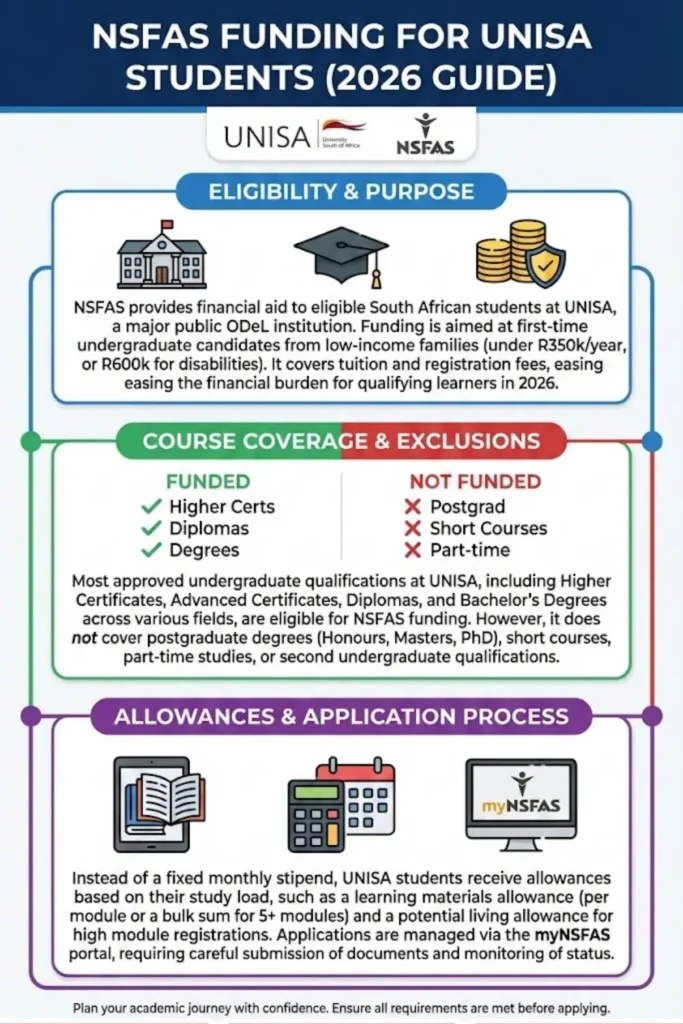
Understanding UNISA and Its Learning System
UNISA is South Africa’s largest public university and operates primarily through an Open Distance e-Learning (ODeL) system.
Key Features of UNISA Learning
- Study from home without attending physical classes
- Online course delivery and resources
- Exams written online under secure systems
- Students rely on laptops, tablets, or desktops
Because it is a public university, UNISA students are eligible for NSFAS funding, which helps bridge the gap for students from low-income families.
You can also read: NSFAS Funds Over One Million Learners
What is NSFAS and Why It Matters
The National Student Financial Aid Scheme (NSFAS) is a government initiative designed to provide financial support to students who cannot afford higher education.
NSFAS Covers
- Tuition fees
- Registration fees
- Study allowances
These allowances ensure students can focus on learning rather than financial stress. NSFAS supports students at public universities and TVET colleges, and UNISA is fully included.
Does NSFAS Fund UNISA Courses?
Yes, but there are some conditions:
- NSFAS only funds approved undergraduate qualifications.
- It covers first-time qualifications; if you already have a degree or diploma, you are not eligible for funding again.
UNISA Courses Funded by NSFAS in 2026
NSFAS covers most undergraduate courses at UNISA, including:
- Higher Certificates
- Advanced Certificates
- Diplomas
- Advanced Diplomas
- Bachelor’s Degrees
If your course is an approved undergraduate qualification, NSFAS usually covers it fully.
Full List of Common UNISA Courses Funded by NSFAS
Below is a list of popular undergraduate courses funded by NSFAS:
| Field of Study | Courses Covered |
|---|---|
| Accounting & Finance | Accounting, Finance, Economics |
| Education & Teaching | Foundation & Advanced Education |
| IT & Computer Science | Information Technology, Computer Science |
| Social Sciences | Psychology, Public Administration, Human Resource Management |
| Business & Management | Marketing, Project Management, Office Administration, Generic Management, Logistics & Transport |
| Media & Communication | Communication Studies, Media Studies |
| Science & Engineering | Engineering, Life Sciences, Physical Sciences, Environmental Sciences, Mathematical Sciences |
| Arts & Culture | Visual & Performing Arts, Language & Literature, Consumer & Cultural Studies |
| Agriculture & Health | Agriculture, Rural Studies, Health & Preventive Services, Early Childhood Development |
Does NSFAS Fund the UNISA Higher Certificate?
Yes, NSFAS funds Higher Certificates, provided:
- It is your first qualification
- You meet NSFAS income eligibility
- The certificate is approved by UNISA
Higher Certificates are ideal for beginners and help students transition smoothly into university-level study.
You can also read: NSFAS Confirms R1500 Allowance
Does NSFAS Fund Short Courses at UNISA?
No. NSFAS does not fund short courses, including:
- Short learning programmes
- Part-time certificates
- Skill-based courses
Even if the courses are beneficial for career growth, NSFAS funding is not available for them.
Courses NSFAS Will NOT Fund at UNISA
NSFAS excludes funding for:
- Postgraduate degrees (Honours, Masters, PhD)
- Short courses and part-time studies
- Private institution courses
- Second undergraduate qualifications
Some postgraduate exceptions exist, but these are rare and students should not rely on them
How Much Do UNISA Students Get from NSFAS Per Month?
UNISA students do not receive a fixed monthly stipend. Funding comes in the form of allowances, which are tied to your study load.
Types of Allowances
- Learning Materials Allowance
- R700 per module for up to 4 modules
- If 5 or more modules: R5,460 once
- Covers textbooks, online tools, and study materials
- Living Allowance
- For students registered in 10 or more modules
- Helps with internet costs, daily study needs, and small personal expenses
Does NSFAS Pay UNISA Tuition and Registration Fees?
Yes. Once approved, NSFAS covers full tuition and registration fees. Students do not pay these costs themselves.
When Will UNISA Students Get Their Second Semester NSFAS Allowance?
Second-semester allowances are usually paid after registration confirmation:
- UNISA confirms your registration
- NSFAS releases funds
- Allowances are paid
Delays may occur due to incomplete registration, incorrect banking details, or pending verification.
How to Apply for NSFAS Funding at UNISA
Applications are submitted via the myNSFAS portal, which also allows:
- Tracking application status
- Uploading documents
- Cancelling applications
Other application methods include:
- Mobile app
- USSD
NSFAS Requirements for UNISA Students
To qualify, students must:
- Be a South African citizen
- Enroll at a public university
- Meet income requirements
Income Limits
- R350,000 per year for most students
- R600,000 per year for students with disabilities
- SASSA grant recipients automatically qualify
Important Registration Advice for NSFAS Students
- First-time students: Register temporarily while waiting for NSFAS confirmation
- Returning students: Also register while awaiting funding
- If declined: Pay fees yourself or appeal the decision
You can also read: SASSA Child Grant Guide Essential Support
Conclusion
NSFAS funding makes studying at UNISA achievable for students from low-income families. With coverage for tuition, registration, learning materials, and allowances for living costs, NSFAS helps students focus on their studies. Most undergraduate courses, including Higher Certificates, Diplomas, and Bachelor’s degrees, are funded in 2026 as long as all requirements are met. Understanding these guidelines ensures you can plan your academic journey without financial stress.
