NSFAS Funds Over One Million Learners Student In South Africa

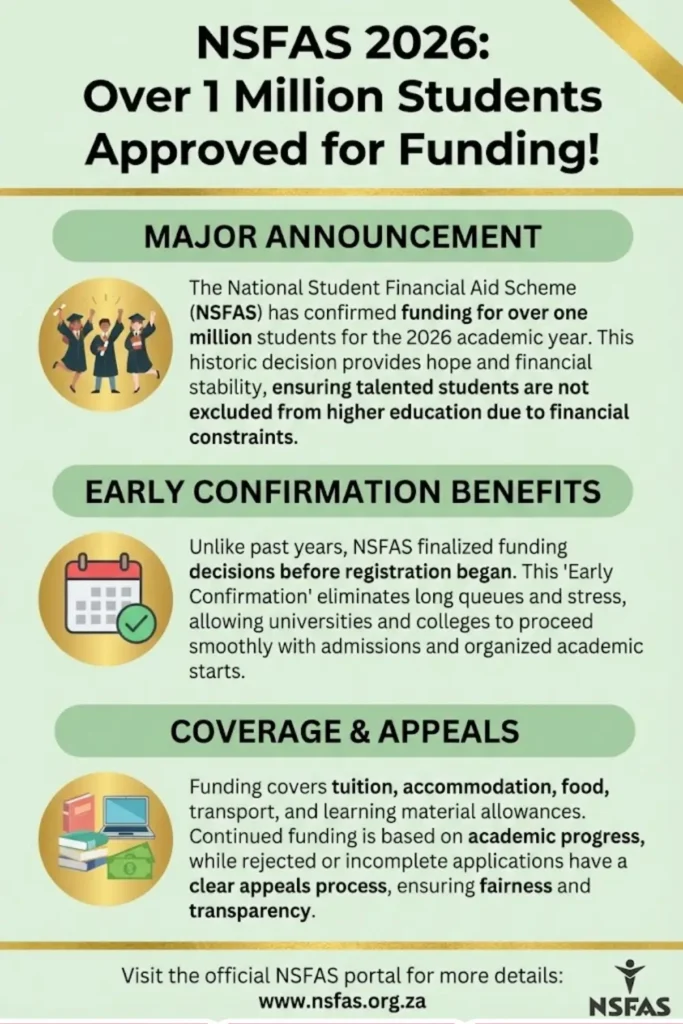
The National Student Financial Aid Scheme, commonly known as NSFAS, has made a major announcement that brings hope to students across South Africa. For the 2026 academic year, NSFAS has confirmed that more than one million students will receive financial support to pursue higher education. This decision comes at a crucial time when many families are struggling with rising living costs and education expenses.
This announcement does more than just provide funding. It sends a clear signal that higher education institutions, including universities and TVET colleges, can confidently move forward with their admissions, registration, and orientation plans. For students, it removes uncertainty and replaces it with clarity, allowing them to focus on preparing for their academic journey instead of worrying about finances.
Why NSFAS Matters for Higher Education Access
NSFAS plays a central role in ensuring that education is not limited only to those who can afford it. In a country where economic inequality remains a challenge, financial aid becomes the bridge between potential and opportunity. Without NSFAS, many capable students would never step into a lecture hall or training workshop.
You can also read: NSFAS 2026 Funding Approved
The scheme is designed to support students from low-income households by covering essential study-related costs. By doing so, NSFAS helps create a more inclusive education system where talent and effort matter more than financial background. The 2026 funding approval reinforces this mission on a massive scale.
Confirmation of Funding for the 2026 Academic Year
Funding approval for over one million students is not a small achievement. It reflects both the growing demand for higher education and NSFAS’s commitment to meeting that demand. The scale of this support shows that the organization has strengthened its systems to manage large volumes of applications efficiently.
This funding covers students enrolled at public universities and TVET colleges, ensuring wide national coverage. The large number of approved beneficiaries also highlights the trust placed in NSFAS as a key driver of educational access.
Early Confirmation Benefits
One of the most important aspects of this announcement is its timing. NSFAS finalized many funding decisions before the registration period began. This early confirmation helps avoid the long queues, delayed registrations, and uncertainty that students faced in previous years.
Key benefits of early confirmation include:
- Faster registration at institutions
- Reduced stress for students and parents
- Better planning for accommodation and transport
- Smoother academic year start
Strong Support for First-Time Students
Focus on New Entrants
A significant portion of the approved funding has been allocated to first-time students entering higher education in 2026. This focus ensures that learners coming directly from high school or other pathways are not blocked by financial barriers at the start of their studies.
By prioritizing new entrants, NSFAS supports the transition from secondary education to tertiary learning. This approach encourages more young people to consider higher education as an achievable goal.
Bridging the Access Gap
For many families, the first year of higher education is the most challenging financially. NSFAS funding helps bridge this gap by covering essential costs and reducing dropout risks during the early stages of study.
Support for first-time students includes:
- Full or partial tuition coverage
- Registration fee assistance
- Access to basic living allowances
Continued Support for Returning Students
NSFAS has also confirmed continued funding for hundreds of thousands of returning students. However, this support is closely linked to academic performance. Students must meet minimum progress requirements to remain eligible for funding.
This system encourages accountability while still offering support. It ensures that public funds are invested in students who are actively working toward completing their qualifications.
Maintaining Accountability
The balance between access and responsibility is critical. NSFAS monitors academic results through institutions, reducing the need for students to reapply each year. Those who fall behind academically may lose funding, but the system also allows room for genuine challenges to be addressed through appeals.
High Volume of Applications Processed
Early Processing Strategy
For the 2026 academic year, NSFAS received an exceptionally high number of applications. Learning from past challenges, the organization focused on processing applications earlier than before. This proactive approach helped minimize delays that previously affected registration periods.
Processing applications early allows institutions to plan better and students to receive clear communication about their funding status.
Lessons from Previous Years
Earlier application cycles faced criticism due to late approvals and system backlogs. The improvements seen in the 2026 process suggest that NSFAS has taken these lessons seriously and implemented practical solutions.
Common Reasons for Incomplete Applications
Despite the improved system, some applications were marked as incomplete. The most common reason was missing or incorrect documentation. Applicants often failed to upload required documents such as proof of income or identity records.
Financial and Academic Ineligibility
Other applications were declined because applicants did not meet financial or academic criteria. NSFAS applies strict eligibility rules to ensure fair distribution of funds.
Common issues include:
- Household income above the threshold
- Failure to meet academic progression rules
- Incorrect personal information
You can also read: SASSA Child Grant Guide Essential Support
Academic Performance as a Core Requirement
How Progress Is Assessed
Academic performance remains a key requirement for continued NSFAS funding. Institutions assess students’ progress based on pass rates and course completion. This process is handled automatically, reducing administrative burden on students.
Impact on Funding Continuation
Students who fail to meet performance standards risk losing their funding. However, NSFAS recognizes that challenges can arise and has built flexibility into the system through appeals.
Appeals Process for Unsuccessful Applicants
Students whose applications were unsuccessful or marked incomplete are given the opportunity to appeal. This includes those who missed documents or faced exceptional circumstances affecting their academic performance.
How the Appeals System Works
The appeals process allows students to submit additional information within a specified time frame. Acting quickly is essential to avoid missing funding opportunities.
Appeals may be submitted for:
- Missing documentation
- Incorrect financial assessments
- Academic challenges due to special circumstances
What NSFAS Funding Covers
NSFAS funding covers full tuition costs at approved institutions. This ensures that students are not excluded from classes due to unpaid fees.
Student Allowances and Support
Beyond tuition, NSFAS provides allowances that support daily student life.
NSFAS funding typically includes:
- Accommodation allowance
- Meal allowance
- Transport support
- Learning materials allowance
Overview of NSFAS Funding Coverage
| Funding Component | Description |
|---|---|
| Tuition Fees | Full coverage at public institutions |
| Accommodation | Approved private or institution housing |
| Meals | Monthly living allowance |
| Transport | Support for commuting students |
| Learning Materials | Books and study resources |
Role of Universities and TVET Colleges
Institutions play a key role in implementing NSFAS funding. They confirm student registrations, monitor academic progress, and manage allowance distribution.
Payment Distribution Systems
Payments are released according to academic calendars, ensuring students receive support throughout the year rather than all at once.
Preparations for the 2026 Academic Year
With funding decisions finalized early, institutions can proceed with registration and orientation without delays. This leads to a more organized start to the academic year.
Reduced Administrative Delays
Early processing reduces long queues and system overloads, benefiting both students and staff.
Impact on Students and Families
For families, NSFAS funding provides major financial relief. It reduces the burden of education costs and allows households to focus on other essential needs.
Improved Educational Planning
Students can plan their studies with confidence, knowing that their financial support is secure.
A Positive Step Toward Educational Equality
Funding over one million students is a strong step toward equal access to education. It ensures that talent from all communities has a chance to grow.
By supporting students consistently, NSFAS contributes to a more skilled and educated workforce, benefiting the country as a whole.
You can also read: NSFAS Confirms R1500 Allowance
Conclusion
The confirmation that NSFAS will fund more than one million students for the 2026 academic year marks a significant milestone for South African education. Early processing, balanced support for new and returning students, and a clear appeals process all point toward a more efficient and student-focused system. This initiative not only eases financial stress but also strengthens confidence in the country’s commitment to accessible higher education.