How To Reapply for NSFAS In 2026 Funding Online Payment Details Step by Step
Reapplying for NSFAS in 2026 can feel overwhelming, especially if your funding was stopped, your application was rejected before, or you took a gap year. Many students panic because they think one rejection means the end of the road. In reality, most NSFAS rejections happen due to small technical mistakes, missing documents, or misunderstandings about the rules.
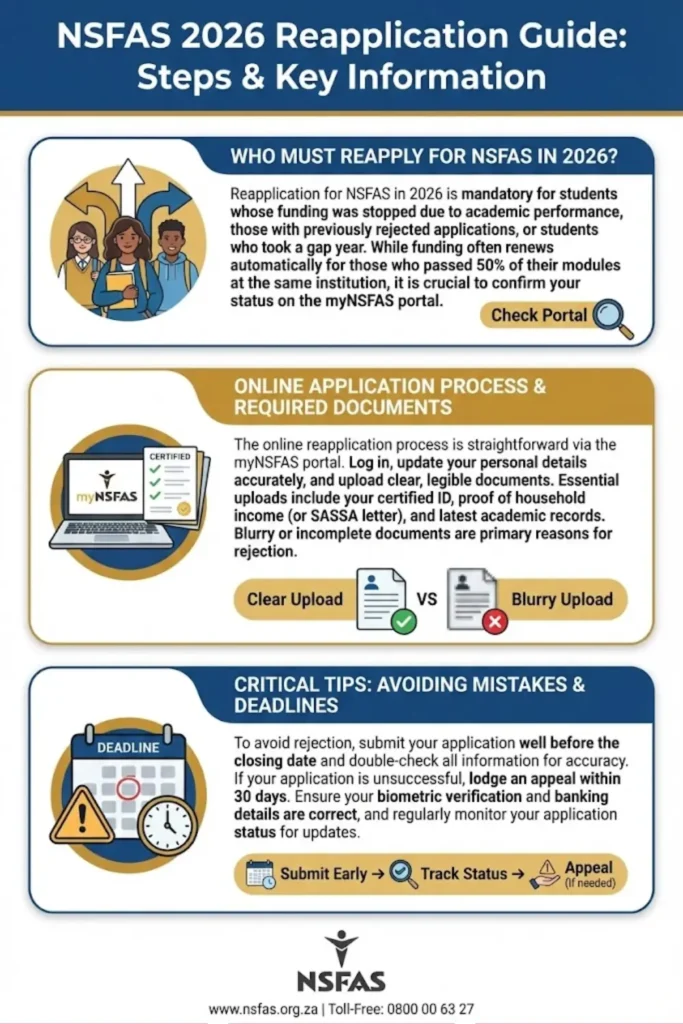
This complete guide explains everything you need to know about how to reapply for NSFAS in 2026, who must reapply, who qualifies for automatic renewal, required documents, payment details, and common mistakes to avoid. The goal is simple: help you submit a clean, complete application with confidence and avoid losing another academic year.
What Is NSFAS and Why Reapplying Matters
The National Student Financial Aid Scheme (NSFAS) is a South African government bursary designed to support students from low-income households studying at public universities and TVET colleges. It covers tuition fees and provides allowances for essentials like accommodation, meals, learning materials, and transport.
You can also read: SASSA SRD Grant Status Check Process 2026
Reapplying correctly matters because NSFAS funding is not guaranteed forever. Funding can stop due to academic performance, study interruptions, or changes in personal circumstances. When funding stops, reapplication becomes your only way back into the system. A single mistake, such as uploading the wrong document, can delay or cancel your funding for the entire year.
Do You Have to Reapply for NSFAS Every Year?
No, NSFAS does not require every student to reapply every year. Some students are automatically renewed, while others must submit a new application. Understanding which group you fall into saves time, stress, and unnecessary paperwork.
Automatic renewal applies only when you meet all academic and administrative requirements. If anything changes, even slightly, NSFAS may require you to reapply. Always confirm your status on the myNSFAS portal instead of assuming your funding will continue.
Who Must Reapply for NSFAS in 2026
You must submit a new NSFAS application if any of the situations below apply to you. These rules are strict, and ignoring them often leads to funding delays.
Previously Rejected NSFAS Applicants
If your NSFAS application was rejected in a previous year, you cannot rely on that old result. You must reapply with updated and corrected information.
Common reasons for rejection include:
- Missing or incorrect income documents
- Mismatched household information
- Blurry or incomplete uploads
- Outdated academic records
Reapplying gives you a fresh opportunity to correct these issues.
Students Who Took a Gap Year
If you took a gap year and did not register for a full academic year, NSFAS funding does not remain active. Once you return to study, you are treated as a new applicant and must reapply from the beginning.
This applies if you:
- Deferred your studies
- Took time off for financial reasons
- Paused studies for personal or medical reasons
Students Who Lost Funding Due to Academic Performance
NSFAS requires students to pass at least 50% of their registered modules. If you failed more than half of your modules, funding may have been stopped.
In this case:
- Funding does not renew automatically
- A new application is required
- Academic performance is reviewed again
Students Affected by the N+2 Rule
The NSFAS N+2 rule limits funding to the minimum duration of your qualification plus two extra years. If you exceed this limit, funding stops.
You must reapply if:
- You exceeded the allowed study period
- You are starting a new qualification
Students Who Changed Institutions
If you moved between institutions and your funding was not transferred, reapplication is required.
This includes moving from:
- One university to another
- A TVET college to a university
NSFAS does not always carry funding across institutions automatically.
Who Does NOT Need to Reapply for NSFAS
You do not need to reapply if you were funded in the previous academic year and still meet all renewal requirements. NSFAS continues funding automatically when everything stays the same.
Automatic renewal applies if:
- You are registered at the same institution
- You passed at least 50% of your modules
- You meet institutional academic rules
- Your household income remains within limits
- You have not exceeded the N+2 rule
Even if you qualify for renewal, always log in to your myNSFAS portal to confirm your status.
You can also read: NSFAS Funding Details for Postgraduate Students
How to Reapply for NSFAS Online in 2026
Reapplying online is straightforward if you follow each step carefully and avoid rushing the process.
Step 1: Log In to Your myNSFAS Account
Visit the official NSFAS website and access the myNSFAS portal.
You will need:
- Your South African ID number
- Your myNSFAS password
If you forgot your password, use the “Forgot Password” option to reset it.
Step 2: Update Your Personal Information
Check all personal details carefully before starting a new application.
Update if necessary:
- Full name and surname
- Contact number and email
- Physical and postal address
Incorrect contact details can cause you to miss critical NSFAS notifications.
Step 3: Start a New NSFAS Application
Click on “Apply” and answer all questions honestly. NSFAS verifies information through government databases, so incorrect details can lead to rejection.
You will be asked about:
- Study history
- Current or intended institution
- Household income
- Previous funding
Step 4: Upload Required Documents
Upload only clear, complete, and readable documents. NSFAS accepts PDF, JPEG, and PNG formats.
Documents must be:
- Clearly scanned
- Fully visible
- Correctly labelled
Step 5: Submit and Track Your Application
Once all sections are complete:
- Click “Submit”
- Save your reference number
- Monitor your application status regularly
You can also read: TVET College NSFAS Payments 2026
Required Documents for NSFAS Reapplication
Each applicant’s document list may differ, but most students are required to submit the following.
Proof of Identity
- Certified copy of South African ID
- Birth certificate for applicants under 16
Proof of Household Income
You may submit:
- Payslips
- UIF documents
- Signed unemployment affidavit
- SASSA confirmation letter (if applicable)
Academic Records
- Latest academic transcript
- Exam results
Proof of Registration or Acceptance
Required if you:
- Changed institutions
- Returned after a gap year
NSFAS Reapplication Timeline for 2026
| Stage | What Happens |
|---|---|
| Application Submission | Online application completed |
| Document Verification | NSFAS reviews uploads |
| Status Updates | Visible on myNSFAS |
| Final Decision | Funding approved or declined |
Processing times vary, so checking your portal regularly is essential.
NSFAS Allowances and Payment Details
NSFAS pays allowances directly to students or through institutions.
Covered allowances include:
- Tuition fees
- Accommodation
- Living allowance
- Learning materials
- Transport (where applicable)
Payments are usually made monthly during the academic year.
What to Do If Your NSFAS Reapplication Is Rejected
A rejection is not always the end.
Submit an NSFAS Appeal
You can appeal within 30 days through the myNSFAS portal.
Appeals are stronger when:
- Income details changed
- Documents were missing before
- Academic performance improved
Reapply in the Next Cycle
If you miss the appeal window or your situation changes later, reapply in the next application period.
Common NSFAS Reapplication Mistakes to Avoid
Many students repeat the same errors every year.
Avoid:
- Uploading blurry or cropped documents
- Using outdated income details
- Missing application deadlines
- Submitting multiple applications
Tips to Increase Your NSFAS Approval Chances
- Apply as early as possible
- Double-check all information
- Track your application weekly
- Respond quickly to NSFAS requests
- Visit your campus financial aid office if unsure
Small details make a big difference.
NSFAS Contact Details
- Website: www.nsfas.org.za
- Toll-Free: 0800 00 63 27
- WhatsApp: +27 63 093 5671
- Email: info@nsfas.org.za
Always use official channels only.
Conclusion
Reapplying for NSFAS in 2026 does not have to be stressful if you understand the rules and follow the correct steps. Whether your funding stopped, your application was rejected, or you took a gap year, NSFAS still offers another chance to qualifying students. The key is knowing when reapplication is required, submitting the correct documents, and avoiding common mistakes. A careful application today can secure your education tomorrow.
You can also read: SASSA Grant Dates Confirmed January 2026
